

Must-Know Utah Landlord Legal Terms
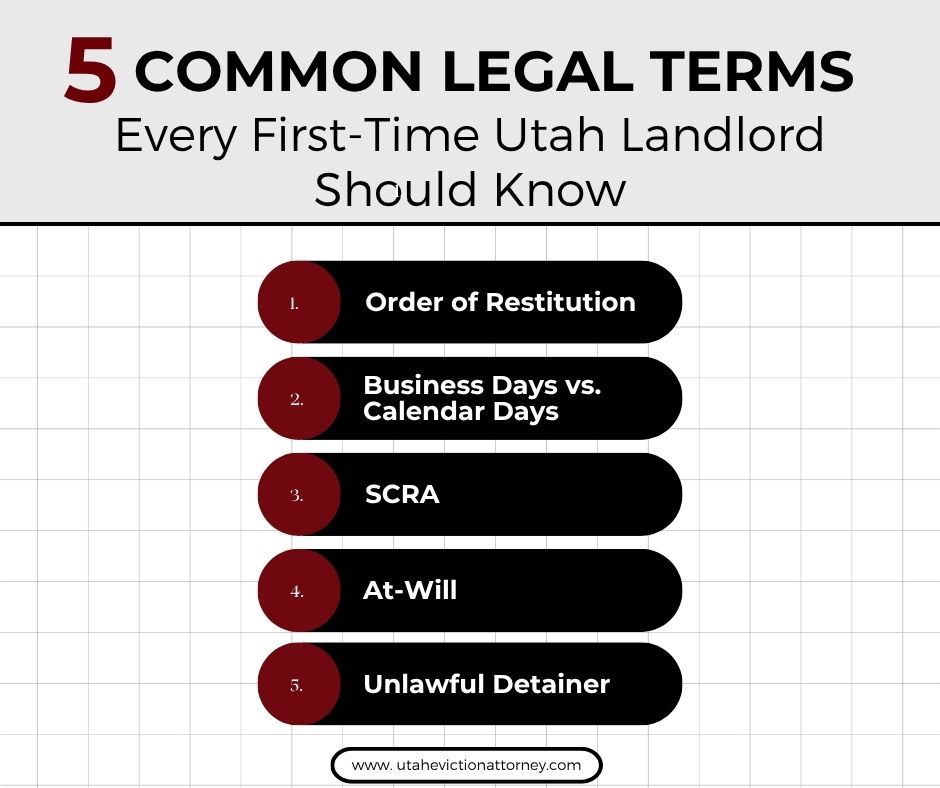
Being a landlord can be daunting! There are so many new things to learn when you become a landlord— not to mention all the legal terms that come along with it. In an effort to ease some of that anxiety associated with property ownership, here are five legal terms that every first-time Utah landlord should know to protect themselves and their property.
1. Order of Restitution
The first legal term that every first-time landlord should know is Order of Restitution. This is the document you need signed by the court in order to remove a tenant from the property. The main goal in an eviction case is to get this document from the court to have the tenant removed.
2. Business Days vs. Calendar Days
One key piece of information that every first-time landlord should know is the difference between business days and calendar days and in what situations which term applies. Different notices and steps in the eviction process require either standard business days or calendar days for the deadline. For example, a 3-day notice to pay or quit requires three business days, whereas a 5-day notice to vacate for an at-will tenant requires five calendar days. Additionally, an Order of Restitution that is served on a tenant and the related deadline to vacate the property is counted in calendar days unless otherwise specified in the Order. Whether business days or calendar days are used to count towards the deadline highly depends on the issue involved and the type of document. It is important to know which type of notice you are serving and whether business or calendar days apply to your timeline.
3. SCRA
SCRA is an acronym for the Servicemembers Civil Relief Act. It is a federal statute that provides protection to active military service members. It is very important for a landlord needing to evict a tenant to be aware of this federal statute. Due to this statute, if a tenant is in active military status, you cannot simply proceed to evict them even if they fail to answer the complaint. The landlord must go through a few other steps with the court to get an order to allow the case to proceed. This is the same with foreclosure– if the homeowner or borrower is in active military duty, you cannot foreclose immediately. You must get permission from the court. The Court usually appoints an attorney to represent the tenant in order to at least find out what the situation is and how they want to handle the case going forward.
4. At-Will
This legal term is used to describe a person occupying your property who has no written lease and does not pay monthly rent. This means they are an “at-will” tenant. Therefore, you can legally give them a 5-day notice to vacate. They do not get a chance to cure any issue, they just have to vacate. Once the notice expires, if they don’t leave then you have to file your lawsuit and pursue further legal action. The 5-day notice is one kind of notice you can give to get rid of an at-will tenant or squatter.
5. Unlawful Detainer
Unlawful detainer occurs when someone is given a notice to either perform some obligation under the lease or vacate, and they fail to do either. Once the deadline of the proper notice expires, if they are still in possession of the property without curing any issue allowed by the notice, they are in unlawful detainer. In other words, they are detaining the property unlawfully. It is at this point that you can proceed with your eviction lawsuit. When they are an unlawful detainer, the tenants become subject to treble damages, three times the rent for every day that they stay there. Additionally, they are liable for attorney fees and costs and triple the damage if they cause any damage to the property at that point as well. Utah law provides pretty significant penalties against tenants just staying in a property when they’re not entitled to do so.
Although knowing these legal terms gives you an advantage as a landlord when you find yourself in a sticky legal situation, each case is unique and requires specific guidance. An attorney can help you navigate it with peace of mind. In the event you need assistance with an eviction, our attorneys can help walk you through the legal process and help you protect your investment in your property.